The pace of change has never been this fast, yet it will never be this slow again.
Justin Trudeau, Davos address, World Economic Forum 2018
The interaction between the enduring nature of war—a fundamentally violent clash of human wills—and the changing character of warfare has rarely been more pronounced. The convergence of pervasive sensor networks, autonomous systems and long-range strike capabilities (including the use of hypersonic, ballistic and cruise missiles) has transformed the contemporary battlefield. The time between detection and action shortens every day and, as a consequence, dispersal and protection have become essential tactical actions once again. Strategic depth has also taken on new meaning, as has the security of both internal and external lines of supply. Persistent contestation of the electromagnetic spectrum means that operating in denied, degraded, intermittent and limited communications environments is becoming the norm. Surviving and succeeding on this battlefield requires military organisations to pivot, and to pivot quickly.
Rigorous academic debate is an essential element of any military pivot. Far from being a detached intellectual exercise, academic debate can—and must—influence and inform military learning and adaptation. It guards against doctrinal complacency, challenges bureaucratic processes and anchors the theoretical scaffolding necessary for new military concepts. The Australian Army Research Centre is responsible for fostering this debate within the Australian Army. This journal, the Australian Army Journal, is one of many important contributions that it produces.
Command, Decision-Making and Decision Advantage
The papers collected in this issue of the Australian Army Journal reflect an Army that is actively grappling with the interaction between the enduring nature of war and the changing character of warfare. One key theme that emerges from many of the papers is the ongoing examination of command, decision-making and decision advantage on the contemporary battlefield. Charles Miller’s analysis of mission command in the littoral environment challenges the trend towards decentralisation, arguing instead for a more contextual and adaptive approach to command, control and decision-making. This opens avenues for further inquiry as to how decision advantage might be achieved through more resilient command-and-control systems that are capable of operating under conditions of disruption. Similarly, a number of contributors engage with the military use (or lack thereof) of AI-enabled decision support tools. For example, Ned Dobos et al. posit that militaries might be under-utilising these tools and suggest that humans might be less influenced by AI-enabled inputs than is often suggested. Together, these contributions underscore one of the key challenges arising from the interaction between the enduring nature of war and the changing character of warfare: how militaries reconcile the relationships between AI-enabled decision-making and trust, ethics and human judgement.
Adaptation and Asymmetry
A second key theme that emerges in this issue is the imperative to adapt quickly—and often—in response to the accelerating pace of change in the character of warfare. Adaptability across all military echelons is not a passive development but a deliberate action that requires emphasis and investment, particularly in the context of robotic and autonomous systems and other emerging technologies. This proposition draws on observations from the Russo-Ukraine War and other contemporaneous conflicts that battlefield and strategic advantage arises from rapid learning, tactical innovation and the integration of emerging technologies with defence industries, at scale. At the conceptual level, Robert Bruce’s critique of ‘asymmetry’ proposes a corrective to prevailing thinking in many militaries. While many aspire to so-called asymmetric approaches, Bruce cautions against the use of such terms and concepts as a rhetorical shorthand or shortcut. Instead, he reminds us of the need for disciplined, problem-oriented thinking.
The Human Dimension
Underscoring the enduring nature of war, a number of contributors argue that the human remains the decisive actor on the battlefield. Contributions on military virtue, ethical decision-making and command judgement collectively posit that character, professional identity and moral responsibility remain central to combat effectiveness and the profession of arms. The 2025 Keogh Visiting Chair, Professor Risa Brooks, makes a particularly important contribution on this theme. She provides a comprehensive examination of civil–military relations as a foundational element of democratic military effectiveness. She frames this as a set of mutual obligations between the public, civil leaders and the military and highlights how robust civilian–military dialogue, candid military advice, informed public engagement and a professional ethic grounded in humility, strategic literacy and self-accountability can safeguard strong civil–military relations. It is an important contribution to the discussion in Australia.
Three Contributions from the British Army
Finally, the Australian Army Research Centre is pleased to publish three outstanding papers from Major Charlie Kenzie, Major Charles Bevan and Major Georgina Edwards, all students at the UK Intermediate Command and Staff Course (Land). These papers reflect on the British Army’s readiness for large-scale combat operations, provide a framework for developing confidence in command, and question the utility (or not) of the operational level of war. Each paper reinforces the utility of armies in war. In the spirit of healthy debate and the contest of ideas, an Australian response has been paired with each paper. We thank the British Army and each of the contributors for their permission to publish these papers in the Australian Army Journal.
Acknowledgements
This edition of the Australian Army Journal is a testament to the state of the profession of arms in Australia at present. I extend my thanks and gratitude to all contributing authors for their scholarship, intellectual courage, and willingness to engage in rigorous debate. This edition—like all those before it—is underwritten by the stewardship of our Editorial Advisory Board. Through its careful oversight, rigorous review processes and high editorial standards, the Board ensures that the Australian Army Journal remains a trusted and credible military publication. I thank the Board and its members for their continued service and commitment to military scholarship within the Australian Army.
‘A Call to Arms’
I trust that you enjoy each of the contributions in this issue of the Australian Army Journal. I encourage you to engage with the arguments presented. None represents the ‘last word’ on its subject. Instead, they are waypoints. The strength of our profession lies not in consensus but in our willingness to reflect, question, learn and adapt. The value of the Australian Army Journal will always depend on the contributions of military professionals (of all ranks), scholars and other partners. Should that inspire you to share your own ideas, insights or experiences, please contact the AARC team to discuss how you might become a contributor.
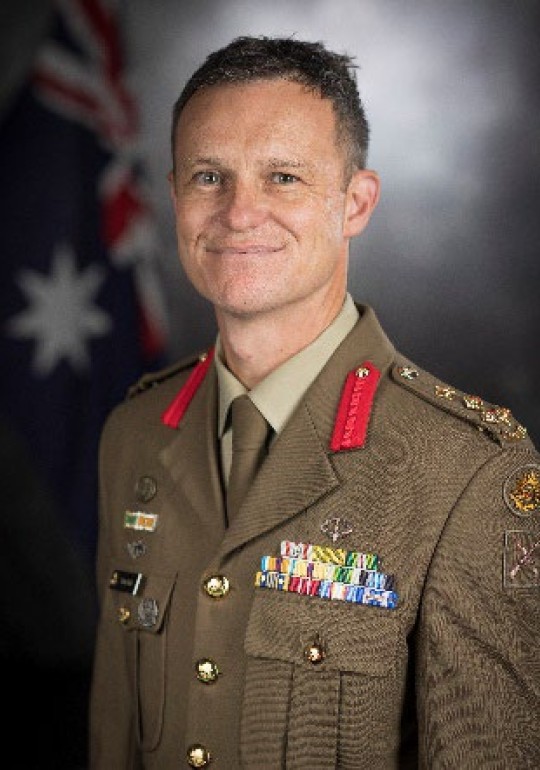
Brigadier James (Billy) Kidd
Director General Future Land Warfare