How the U.S. Military Learned to Manage the Media and Public Opinion
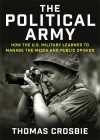
Columbia University Press, 2025, 280pp
Paperback ISBN: 9780231219785
Hardcover ISBN: 9780231219778
E-book ISBN: 9780231562898
Author: Thomas Crosbie
Reviewed by: Julian Weaver
The current geopolitical landscape, saturated with fake news and generative artificial intelligence (AI) capable of fabricating video and photographic media, presents a unique social and political challenge. Furthermore, the westernisation and idealisation of war movies raises questions about how integrated militaries must be with media and public opinion. There is no longer a strict separation that allows militaries to remain truly apolitical;[1], [2] rather, the successful adoption and integration of media and reporters into military units now generates significant strategic and tactical benefits.
Thomas Crosbie’s The Political Army aims to account for this ‘democracy of war’, specifically the entwining of the media and the military from 1939 to 2000. Thomas Crosbie is an Associate Professor of Military Operations at the Royal Danish Defence College, with numerous published titles on the military profession, military politics and professional military education. The book investigates the democratic and civilian oversight of militaries that has emerged alongside advances in recording and distribution technology. Specifically, it provides insight into the varying degrees of media involvement permitted by militaries (ranging from micro-level management to holistic access) and into the second- and third-order effects of this. Crosbie argues that although the US Army has historically viewed itself as an apolitical institution, it has often adopted a profoundly political warfighting approach, including varying attempts to repress or accept media integration over the 60 years covered within the book.
The book provides an in-depth account of the development of military media management. This is a field which, as Crosbie notes, has not been covered in much depth previously, outside of the Sidle Panel report (1984), the monograph Vietnam 10 Years Later: What Have We Learned? (1984), and Joint Publication 3-61: Doctrine for Public Affairs in Operations (1997).[3] In pursuit of best practice, Crosbie frames the point where Army and media engagement first fell out of sync in the post-World War II era. The Page Report of 1945, submitted to military and political leadership, underscored the ‘centrality of messaging activities to military success’, sparking the initial rise of the US Army’s public affairs department.[4] This was followed by the conflict in Korea, where MacArthur initially freed the press to report as they saw fit. However, this latitude quickly materialised into proof for the Army’s top leadership of the ‘severe issue’ with a free press, particularly regarding reporting on low morale.[5]
It is from this basis that Crosbie explores the Vietnam War era of the 1960s and 1970s. Here, the ‘mightiest global military power’ commenced battle with the guerrillas and regular forces of a singularly underdeveloped nation. Assessing the situation as a ‘recipe for disaster’, Crosbie contends that the Vietnam War revealed a singular truth—that ‘Operational victory and political victory are fundamentally decoupled’.[6] Crosbie’s concept of this so-called ‘Tet Paradox’ offers clear insight into how poor media management and attempts at ‘Army utopianism’ (attempts to strongarm civilian opinion through operational success) can lead to dissatisfaction and the withdrawal of public support. Unfortunately, the post-Vietnam period was marked by the suppression of this critical lesson, a lesson that still resonates today. As Crosbie notes, ‘Public affairs were downgraded and removed from operational concerns by [General William] DePuy (1975) and [General Donn A] Starry (1982) … despite increasingly [becoming] an element of top commanders’ daily lives’.[7]
The book continues through the 1983 invasion of Grenada to explore how, despite the doctrinal downgrades by DePuy and Starry, media management remained relevant. Suppression of reporting or media access, Crosbie notes, ‘was never absolute … [military public affairs officers] found work to occupy and justify their place’.[8] These events set the stage for Operations Desert Shield and Desert Storm, which better utilised the lessons from Vietnam (finally explored in the Sidle Panel report of 1984). This period saw the establishment of media pools—a logistical system that grants a small, rotating group of journalists access to restricted conflict zones. In an effort to reflect upon an expanding and fracturing ‘mediascape’ with 24/7 news channels, Crosbie attributes the successful integration of military public affairs officers (PAOs), civilian media reporters and the media pool framework as the basis for the US Army’s standing today as the ‘most trusted institution in American public life’.[9]
It is unfortunate that The Political Army abruptly ends its analysis prior to the terrorist attacks in the United States on 11 September 2001. Instead, it finishes with a discussion about the October 2000 publication of Field Manual 3-61.1, which enshrined public information as a central element of US military planning. As a result, the book’s ending feels artificial, concluding with doctrine but missing the critical test of its execution during Operation Enduring Freedom. Given this omission, the stage is indeed set for a complementary analysis, using Crosbie’s framework, to question whether the ‘Tet Paradox’ has been solved or has instead been supercharged by the digital age. Observations from the Iraq and Afghanistan conflicts would necessarily inform such analysis.
If Vietnam demonstrated that a free press could decouple tactical success from strategic victory, the current era of social media and generative AI threatens to shatter that link entirely. We have moved from the ‘Golden Hour’ of news cycles to the ‘Golden Second’ of social media, where narratives are established by algorithms and influencers long before a PAO can verify facts. The ‘Tet Paradox’ is no longer just about a trusted news anchor like Walter Cronkite as ‘the most trusted man in America’ swaying opinion. It is about decentralised disinformation campaigns, deep fakes, and echo chambers that render ‘objective’ military truth increasingly irrelevant. In this sense, The Political Army acts as a foundational textbook on media mismanagement. It does, however, require the reader to actively bridge the gap between the year 2000 and today’s ‘mosaic war’, where the weaponisation of information is as decisive as kinetic force. While the academic style of the book may make it less accessible to a general audience, it nonetheless contains substantive contributions that make it worthwhile reading for policymakers, PAOs and staff officers. This is especially so given the recent focus of Lieutenant General Simon Stuart, Australia’s Chief of Army, on the army profession. Specifically, he has proposed a ‘jurisdiction’ pillar that explores Army’s relationship with the society it serves.[10] In this context, Crosbie’s The Political Army is a valuable case study for Army to consider in examining whether it is doing enough to ensure that its story, and its contribution to national defence, is being heard by the society it serves.
Endnotes
[1] Huntington’s concept of objective versus subjective civilian control of the military—see Chapter 4 of Samuel P Huntington, The Soldier and the State: The Theory and Politics of Civil–Military Relations (Cambridge MA: Harvard University Press, 1957).
[2] See Morris Janowitz’s ‘Convergence Theory’ as discussed by Cate Carter, ‘The Janowitz Citizen’, Australian Army Research Centre (website), 28 August 2019, at: https://researchcentre.army.gov.au/library/land-power-forum/janowitz-citizen.
[3] See Richard Halloran, ‘Pentagon Issues News Guidelines for Combat Zones’, The New York Times, 24 August 1984, at: www.nytimes.com/1984/08/24/world/pentagon-issues-news-guidelines-for-combat-zones.html; Howard K Smith et. al, Vietnam 10 Years Later: What Have We Learned? (Defense Information School, 1984).
[4] Thomas Crosbie, The Political Army: How the U.S. Military Learned to Manage the Media and Public Opinion (Columbia University Press, 2025), p. 55.
[5] Ibid., pp. 62–74.
[6] Ibid., p. 98.
[7] Ibid., p. 137.
[8] Ibid., p. 158.
[9] Ibid., p. 188.
[10] See, for example, Simon Stuart, ‘Strengthening the Australian Army Profession’ (speech), Lowy Institute, Sydney, 3 April 2025, transcript at: https://www.army.gov.au/news-and-events/speeches-and-transcripts/2025-04-03/strengthening-australian-army-profession.