
The Conception and Implementation of Field Service Regulations 1900–1918
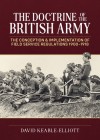
Helion and Company Ltd, Warwick, 2025, ISBN 9781804517680, 265pp
Author: David Keable-Elliott
Reviewed by: Chris Roberts
Many military historians surmise that the British Army went to war in 1914 without a warfighting doctrine.[1] They base their opinions on the fact that Field Service Regulations 1909 (FSR) did not present the clear rules and strictures found in the French and German armies’ doctrines. David Keable-Elliott rejects that view. In The Doctrine of the British Army he argues persuasively, and correctly in this reviewer’s opinion,[2] that two pocket-sized books (Part I Operations and its companion volume, Part II Organization and Administration) provided a doctrine for the British Army. While largely based on principles to be applied depending on the situation and conditions facing commanders, FSR laid down clear and firm guidance on command, on the conduct of military operations, and on the organisation of the administrative and logistic support for an expeditionary force. Moreover, Keable-Elliott believes that this doctrine (with some adaptation in certain areas and when correctly applied in action) served the British Expeditionary Force (BEF) well on the Western Front for the duration of the war.
Keable-Elliott’s book is presented in two parts. Part I is devoted to the prewar years. These 10 chapters provide a detailed account of the inception and development of FSR through various drafts and manuals issued from 1902. Keable-Elliott discusses the fundamental principles contained in them, the way in which they were tested and revised, and the manner in which the agreed doctrine was implemented throughout the Regular Army prior to the outbreak of the Great War (1914–1918). Part II (10 chapters) covers the application or otherwise of FSR on the Western Front through to the end of the war. It largely provides analysis and observations on the tactical and administrative instructions issued during the conflict, with an emphasis on the extent to which they accorded with FSR. In each part, Keable-Elliott includes a chapter on the historiography of FSR relating to the prewar years, and later on the Western Front. In each of these chapters, he highlights the lack of—or, at best, brief—mention of FSR in the military histories covering these periods written by professional and academic historians. These omissions, he asserts, have led to flawed assessments and even inaccuracies in many of those histories, and he provides examples to support his case. He ably rejects the view held by many historians that Sir Douglas Haig was the author of FSR, highlighting (in some detail) those authors who credit Haig with their production.
The central theme of the book is that FSR provided a sound warfighting doctrine for the British Army. While aspects of the doctrine had to be adapted to fit the environment facing the BEF in France (especially regarding logistics, administrative, and artillery command arrangements), Keable-Elliott argues that when the principles in FSR were applied they resulted in success, but when they were ignored, failure ensued. Here Keable-Elliot’s argument is somewhat simplistic given the many factors that also contributed to wartime failures. While his claim has some foundation, Keable-Elliott tends to push his case too far, with some questionable examples and observations, and a certain rigidity in his views on the application of FSR’s principles. Despite this criticism, Part I of The Doctrine of the British Army provides a valuable insight into the approach the British Army took to producing and implementing a warfighting doctrine.
FSR embodied an approach to command that is still relevant today. Specifically, the guidelines gave considerable latitude for initiative and judgement in determining a course of action, depending on the operational situation facing commanders. Much of that guidance is applicable a century later, including the importance FSR placed on decentralised control (today called mission command), reconnaissance, covering fire during the infantry assault, and combined arms tactics. As a study in the production of doctrine, Keable-Elliott’s work demonstrates the importance of top-down involvement, testing the doctrine on annual Army-level manoeuvres, high-level annual conferences to debate the issues being considered, and revising the doctrine in accordance with the agreed conclusions. He also shows the extent of efforts to implement the regulations. Specifically, FSR was implemented throughout the Regular Army, and commanders (at all levels) were held responsible for training their officers according to the guidelines. Supporting this endeavor, an Inspector-General toured commands to report on whether units were conversant with the application of FSR, and promotion exams tested officers’ knowledge of how to apply the principles contained in the manuals.
Keable-Elliott admits that he is not from a military background;[3] nor does he seem to have a sound knowledge of the operational issues confronting the combatants on the Western Front. This is evident in some of his analysis in Part II of the book. Nonetheless, he believes he has had authoritative guidance from the diaries and letters of his grandfather, a junior artillery officer during the war. Much of this portion of the book is devoted to an assessment of the tactical and administrative instructions issued by BEF General Headquarters during the war, and whether they reflected the doctrine contained in FSR. Much of this assessment concerns artillery and command issues. While many of his observations are reasonable, Keable-Elliot has a tendency to take his criticisms too far. For example, when discussing Central Distribution Service (CDS) 50 Tactical Notes issued in July 1915, he states that it makes no reference to FSR and that it does not engage with FSR principles. Consequently, it is ‘not an impressive document’. He criticises omissions of certain FSR principles, despite the fact that the instruction contains sound information applicable to the use of artillery fire. This tendency to criticise those instructions that, to his mind, do not accord with FSR is evident in other areas. Where instructions do accord, he is complimentary about them. Nonetheless, Part II of The Doctrine of the British Army contains useful information on how the British Army adapted to meet the new conditions facing them on the Western Front—but Keable-Elliott’s observations and criticisms need to be viewed with care.
A secondary theme running through the book is an ongoing criticism of Sir Douglas Haig. Keable-Elliott’s bias against Haig shows its hand early when he implies that his grandfather did not necessarily respect Haig. While several of Keable-Elliott’s criticisms of Haig are justified, much of his position is informed by his view that Haig was not imbued with the principles of FSR and did not always follow them. At times Keable-Elliott’s stance borders on churlishness, and at other times it seems to be based on assumptions about Haig’s views concerning the manuals, rather than direct evidence. Recognising that some may regard his book as ‘a sustained attack on Haig and his contribution to victory’, Keable-Elliott rejects this, stating that his approach merely avoids ‘Haig-centrism’. Subsequently, in the penultimate chapter, he lauds Haig as a ‘great war leader’ for addressing the many logistical and administrative problems facing the BEF when he became Commander-in-Chief. Furthermore, he credits Haig for his prescient handling of artillery (something he appears to criticise the man for in earlier chapters), stating that FSR was not always applicable and adherence to it was not always the right course. This simply adds to a sense of contradiction running through the book.
Despite some flaws and bias in its arguments The Doctrine of the British Army is a useful addition to the historiography of the British Army in the early 20th century. This is especially the case in relation to the development and implementation of the British Army’s doctrine during the prewar years. Above all, the book firmly establishes that the British Army had a clear and largely enduring warfighting, administrative and logistical doctrine when it went to war in 1914. However, a more objective and impartial study of how FSR was applied and adapted to meet the new conditions confronting the BEF on the Western Front still awaits us.
Endnotes
[1] See for example Spencer Jones, From Boer War to World War: Tactical Reform of the British Army, 1902–1914 (University of Oklahoma Press, 2013), p. 56; Stephen Badsey, Doctrine and Reform in the British Cavalry 1880–1918 (Aldershot: Ashgate, 2008), p. 4; Albert Palazzo, Seeking Victory on the Western Front: The British Army and Chemical Warfare in World War I (University of Nebraska Press, 2000), pp. 8–17; Shelford Bidwell and Dominick Graham, Fire-power: British Army Weapons and Theories of War 1904–1915 (London: Allan & Unwin, 1982), pp. 2–3, 295; Tim Travers, The Killing Ground: The British Army, the Western Front, and the Emergence of Modern Warfare, 1900–1918 (London; Boston: Allen & Unwin, 1987), p. 41; Andy Simpson, Directing Operations: British Corps Command on the Western Front 1914–18 (Spellmount, 2006), p. 20; Aimée Fox, Learning to Fight: Military Innovation and Change in the British Army, 1914–1918 (Cambridge University Press, 2017), pp. 20–21.
[2] See Chris Roberts and Paul Stevens, The Artillery at Anzac: Adaptation, Innovation and Education (Newport, NSW: Big Sky Publishing, 2021), pp. 20–26. They argue that the prewar British manuals represented a flexible warfighting doctrine based around principles to be applied according to the situation.
[3] He is a medical general practitioner.