
Ten Conflicts That Explain the New Middle East
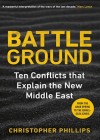
Yale University Press, 2024, ISBN: 9780300263428, 320 pp.
Author: Christopher Phillips
Reviewed By: William Westerman
Few regions on earth manage to take hold of international attention quite like the Middle East. A stark reminder of this fact was the large-scale terrorist attack conducted by the Palestinian Islamist group Hamas against southern Israel on 7 October 2023, followed by Israel’s devastating two-year war in Gaza to recover hostages and destroy the perpetrators. External interest in the region is multifaceted: in some instances it has been driven by geopolitics, such as by superpower competition during the Cold War; in other cases it has to do with energy resources, particularly the abundance of oil found in the Persian Gulf and its surrounds. For the world’s Muslims, the Middle East is home to many of their most sacred sites, while Christians and Jews have theological ties to the land between the Jordan River and the Mediterranean. There is also a considerable degree of emotion invested in the perpetually fraught Arab–Israeli conflict, especially among diaspora communities.
For all the wealth of commentary and activism that takes place in relation to wars and unrest in the Middle East, one suspects that, among the general public, the level of detailed knowledge about the topic is relatively low. Seeking to address this deficit is Christopher Phillips, a Professor of International Relations at Queen Mary University of London and an Associate Fellow at Chatham House. His recent book Battleground: Ten Conflicts that Explain the New Middle East explores several conflicts that have plagued the region over the past two decades. In so doing, Phillips seeks to challenge pervasive and simplistic explanations of how and why they have erupted, such as religious sectarian differences, ancient hatreds and the legacy of colonialism. Instead, he sets out his argument in the book’s first sentence: ‘The international relations of the Middle East are complicated.’[1] The remainder of the book serves to demonstrate this complexity.
As its subtitle indicates, Battleground is divided into 10 chapters, each covering an area of the wider Middle East that has experienced conflict in recent years and particularly since 2011. The areas covered are Syria, Libya, Yemen, Palestine, Iraq, Egypt, Lebanon, Kurdistan, the Gulf states and the Horn of Africa. Each chapter provides history, geopolitical context and a narrative of recent events for the respective locality, explaining the various factors that have caused conflict, whether intranational or international. The book’s focus is political, military, diplomatic and occasionally economic; thus those seeking social and cultural surveys of the region need look elsewhere. Each chapter also examines the role of external players in regional unrest. This consideration naturally includes the United States but also covers Russia, Qatar, Saudi Arabia, Israel, Iran, the European Union, Turkey, China and the United Arab Emirates (UAE). This array of external actors is a valuable demonstration of how much ‘local’ intervention by regional powers such as Iran and Saudi Arabia is a feature of conflict in the region. If nothing else, Battleground is a helpful corrective against the solipsistic view of some in the West that all conflicts in the world come about as a result of either Western action or Western inaction.
Certain themes run throughout the book. For instance, it is notable how much foreign intervention by regional powers has occurred in the interests of regime preservation, often in response to the so-called ‘Arab Spring’ in 2011. For instance, following protestors’ demands for political reform in Bahrain inspired by the fall of Egyptian President Hosni Mubarak (and driven largely by the country’s Shi’a community), both Saudi Arabia and the UAE were worried a Shi’a-led revolution could create a pro-Iranian satellite on their doorstep. As a result, 2000 troops deployed from both countries, as well as from Qatar, to help the regime quell the unrest. Another theme concerns the decline of US influence and intervention in the region since the presidency of Barack Obama and the rise of regional actors to fill the void. In his conclusion, Phillips offers his view as to whether a return to US dominance in the Middle East is in the best interests of both the United States and the region.
The great value of Battleground is that Phillips has impressively condensed the labyrinthine politics of each of the 10 localities into digestible chapters, allowing a reader to gain a solid overview of each topic from a reputable scholar. The book is particularly valuable for those seeking insight into conflicts where Western attention has been limited. In this regard, Phillips’s canvassing of the Horn of Africa and of Saudi Arabia’s meddling in Yemen are among the most valuable chapters, as is the discussion of Kurdistan, often neglected because it is not a formal nation state in the traditional form.
Specialists and those with a deep knowledge of the areas under examination would no doubt find quibbles with the representations of each conflict, pointing to insufficient specificity or nuance. For instance, in his discussion of Iraq, Phillips neglects to note that Saddam Hussein’s regime sought to retain possession of weapons of mass destruction following the 1991 Gulf War, and that its attitude towards international disarmament efforts heavily influenced the US decision to invade the country in 2003.[2] This is a minor point but it illustrates the way in which Phillips has needed to elide certain details to avoid being bogged down. The book is perfectly manageable at 320 pages; to have added additional detail would probably have defeated its purpose, which is to provide a broad overview of conflicts to an educated non-expert.
Phillips writes with knowledge and authority but always, as he acknowledges early in the book, as a Western outsider. In addition, books like this are always hostage to the moment and risk becoming dated when they are overtaken by events. In the chapter on Syria, for instance, President Bashar al-Assad is still clinging to power.[3] With the book published in June 2024, Phillips was not to know that in December that year Assad’s regime would collapse and he would flee to Moscow. Similarly, in writing about Palestine, Phillips cannot do more than sketch out the start of the war in Gaza, leaving readers to pick up elsewhere the significant developments that have occurred since 7 October 2023. Such gaps in recent history do not undermine the value of the book as a summation of recent history, yet readers would do well to make themselves aware of developments that are more contemporary.
Ultimately, for those with the desire to know more about the Middle East, Battleground serves as an authoritative introduction to the conflicts of the region, admirably achieving the author’s intention of demonstrating the complexity of the region and its many tensions and fracture points. The book can be read from cover to cover but its structure also enables it to function as a reference book, enabling readers to engage with separate topics in the largely self-contained chapters. At the end of the book, Phillips provides a modest selection of further readings for anyone wishing to follow up on any particular locality. With the Middle East unlikely to recede from global significance any time soon, this is a valuable resource for anyone wishing to begin thinking deeply about the region.
Endnotes
[1] Christopher Phillips, Battleground: Ten Conflicts That Explain the New Middle East (New Haven CT: Yale University Press, 2024), p. 1.
[2] Ibid., pp. 122–23.
[3] Ibid., p. 18.