
Authors: Ned Dobos, Christine Boshuijzen-van Burken, Deane-Peter Baker, Milad Ghasrikhouzani, Erandi Hene Kankanamge, Twan Huybers, Oleksandra Molloy, Jo Plested, Abhi Veda
Introduction
Artificial intelligence (AI) software systems can process and interpret large and often complex data through previously learned (or sometimes live-learning) pattern-finding, inferencing and prediction algorithms. If AI-enabled decision-support tools were to be integrated into military operations—for example, if an AI-based object detection and classification tool were integrated with a camera feed and could quickly bring weapons, camouflage or military vehicles to a soldier’s attention—would this have positive ethical consequences or negative ones? Military ethicists are divided on the answer to this question.
According to more optimistic narratives, AI-enabled technologies such as object classification and detection tools will not only make our armed forces more effective in battle; they will also reduce unintended civilian casualties and could mitigate the various other mistakes that regularly occur in the fog of war, where there is limited information and even more limited time available to reach decisions.[1] According to more pessimistic narratives, on the other hand, the introduction of these technologies is liable to open up a ‘responsibility gap’ that undermines the average soldier’s exercise of moral self-restraint. The pessimists are concerned that the more armed forces personnel can ‘blame’ their technological aides when things go awry, the less incentive they will have, and the less care they will take, to make sure that things do not go awry.[2] There is also longer-term disquiet about so-called ‘moral deskilling’, as pointed out by Shannon Vallor.[3] The worry here is that, to the extent that AI-enabled decision-support systems relieve armed forces personnel of the burdens of ethical decision-making under pressure, the capacity of these personnel for such decision-making will become atrophied over time.[4] Once the human in a human–machine environment does become morally deskilled in some such way, what will become of them outside this narrow setting, in contexts where they do not have the luxury of being paired up with a machine that helps them reason and act morally?
Notice that both the optimists and the pessimists share a common assumption: that once AI-enabled decision-support tools are made available to armed forces personnel, those personnel will actually pay attention to, and give consideration to, the inputs of those tools. For the pessimists, the adverse consequences of this will exceed the benefits, while for the optimists, the pros outweigh the cons. Neither side entertains the possibility that these technologies will have little or no discernible effect in either direction; both assume potentially significant consequences. Our research suggests that that this starting assumption warrants closer scrutiny.
The experiments described in this article yielded an interesting—and somewhat surprising—result, one that supports neither the optimistic nor the pessimistic narratives recounted above. What our research suggests is that, at least under certain circumstances, the integration of AI-enabled decision-support tools might have neither positive nor negative effects, simply because the human decision-makers using these systems will not give their inputs any significant weight in their deliberations. In our experiments, the human decision-makers seemed to be confident enough in their own direct sense perception that the introduction of AI-generated inputs made no detectable difference to their decision-making, for the better or for the worse.
This of course does not mean that these technologies will not have any observable effect—positive or negative—when actually integrated into real-world battlefield decision-making. That would be too hasty a conclusion to reach. Rather, it suggests that more research is needed to determine when a human who works closely with an AI-based decision-support system will actually give credence to the data generated by that tool, and when they will not. The default assumption among most researchers in this space is that this data will always be given some consideration by the human agents exposed to it, but our findings suggest that this may not necessarily be the case. Unlike previous research, which attempted to measure the effects of AI on moral decision-making through surveys alone, our project exposed participants to realistic simulations in which moral decisions were required, and monitored the actual choices and behaviours of these participants.[5] Modern military personnel are faced with a plethora of ethical choices in the course of their duties but, for the sake of simplicity, our experiments focused exclusively on the application of lethal force, presenting participants with a simplified ‘shoot / no-shoot’ predicament.
Section 1: The Optimistic Story
In a description of the emerging combat environment, David Kilcullen contends:
[It] is likely to include a wider range of actors with access to a more capable array of high-end lethal technologies. These may be ‘onboard’ capabilities embedded within combat elements or carried at unit or formation level within a force, or distributed capabilities that combat actors can access through collaborative engagement techniques, dispersed operations or access to artificial intelligence capabilities, allowing them to reach back for remotely held support. In the case of state actors, this is likely to translate into increased levels of precision, lethality and manoeuvrability down to the small-team level (sections, combat pairs or even enhanced individuals). In the case of non-state actors, it will be manifested in individuals and small teams deploying levels of lethality that were previously restricted to large groups or government organisations.[6]
Kilcullen clearly depicts the impact of AI and related technologies as a double-edged sword in the sense that it has the potential to enhance the capabilities of both sides in any conflict. The above passage is nonetheless an example of what we call the ‘optimistic story’ about the military employment of AI—that is to say, those who take this view see AI as a means to making military capabilities more effective. Advantage over adversaries in AI capability is seen as equating to military advantage in a number of critical areas. The Australian Defence Force (ADF) Concept for Robotic and Autonomous Systems makes a similar point.[7] Vladimir Putin stated about AI in the context of geopolitical strategy in 2017 that ‘whoever becomes the leader in this sphere will become the ruler of the world’.[8] Friend and foe alike have high expectations of military AI and agree that the strategic potential of AI is immense.
On a tactical and technical level relevant to our project, it is often argued that AI in military systems will significantly enhance decision-making processes. For example, Ian Langford writes that ‘AI now enables … militaries … to make more accurate decisions via predictions, classifications and clustering’.[9] Through the narrower scope of military targeting, this improved decision-making is seen as resulting in further improvements in precision. And while precision is not distinction in the sense required by the laws of armed conflict and international humanitarian law (IHL), it is an obvious enabler for those seeking to abide by this fundamental norm of the jus in bello. Distinguishing between combatants and non-combatants in the conduct of war is morally expected and legally obliged.
In addition to enhancing the quality of military decision-making processes, the optimistic story also emphasises the potential for AI to vastly increase the speed with which those decisions are made. Ian Reynolds notes, ‘AI-enabled technologies are promoted as the path towards attaining the required speed to compete and win on modern battlefields’, following the mantra that ‘faster war is better war’.[10] Being able to effectively handle the increased pace of war increases the likelihood that combatants will maintain the ability to conduct strikes, operations and campaigns within the bounds of IHL and the ethics of war.
Beyond better and faster decision-making, optimists expect AI to lead to increased effectiveness across the military enterprise. By augmenting the capabilities of human soldiers and optimising the use of resources, AI will work as a force multiplier.[11] While the link here to ethics is not immediately obvious, it becomes clear when we take seriously the fact that soldiers are far more likely to conduct themselves appropriately when they are deployed with the appropriate support and capabilities. (Consider, by contrast, what happened when under-resourced and poorly equipped Dutch soldiers faced the responsibility to protect vulnerable civilians at Srebrenica.)[12] Also worth mentioning, though not of direct relevance to our project, is an optimistic story around the use of AI-enabled autonomous robotic systems to relieve human soldiers of the most ‘dirty, dull and dangerous’ battlefield tasks.[13]
Section 2: The Pessimistic Story
The use of AI-powered decision-support systems in warfare raises significant ethical concerns, particularly the risk of over-reliance.[14] This occurs when human operators place unfettered trust in these systems, accepting their outputs and following their recommendations without sufficient scrutiny—even when these conflict with the operator’s own judgement, critical thinking or situational awareness. For instance, a commander might follow an AI-generated targeting suggestion without confirming its consistency with the rules of engagement or mission objectives. This is especially troubling because errors in data, sensor inaccuracies or algorithmic biases can lead these systems to make errors, such as misidentifying illegitimate targets as legitimate ones.
There are several reasons why humans might place undue trust in AI systems, but one of the most prominent is automation bias.[15] Coined in social psychology, this term captures our tendency to overvalue the judgements of computerised systems simply because they appear objective, precise and technologically advanced. We often assume these tools are smarter or more reliable than they really are. But at its core, automation bias may stem from a deeper cognitive shortcut. The human brain is frequently described as a cognitive miser—wired to conserve energy by simplifying complex decisions whenever possible.[16] AI decision-support tools play right into this instinct, offering ready-made answers and relieving us of the burden of deliberation. In light of this, some would say that over-reliance on AI decision-support tools is not just predicable but practically inevitable.
In its most severe form, automation bias can reduce human operators to passive spectators—mere extensions of the technology they are supposed to supervise. Rather than critically engaging with AI outputs, they may become reluctant to question them, defaulting to a stance of deference. This dynamic gives rise to two distinct types of errors. Commission errors occur when individuals blindly follow system recommendations and disregard conflicting evidence, even that which comes from their own observations. Omission errors, on the other hand, arise when a system fails to prompt an action and the human, having become too dependent on automated cues, fails to respond at all. Both error types reveal how over-trust in automation can quietly erode human judgement.[17]
Another factor fuelling over-reliance on AI systems is what some refer to as moral buffering—a psychological strategy, often unconscious, that helps individuals sidestep feelings of guilt or shame when making difficult decisions.[18] When a human operator acts on personal judgement, they may feel confident in their choice at the time. But if the outcome is disastrous, the emotional consequences—regret, remorse or even moral distress—can be hard to escape. By contrast, when the decision is outsourced to a machine, accountability feels more dispersed. The burden of responsibility can be shared with the system itself or with the wider chain of command that authorised its use. In this way, deferring to automation offers a kind of emotional insulation—a way to avoid the sting of personal blame or the deeper psychological toll that moral failure can inflict. Unfortunately, this can lead users to prioritise self-protection over sound judgement, choosing the path of least moral resistance even when it undermines mission effectiveness and inflates the danger of blind reliance on AI.
Over-reliance on technology can lead military practitioners to make flawed decisions and to produce harmful—or at least sub-optimal—outcomes, but that is not all. If these individuals repeatedly outsource their decision-making to AI-enabled systems, there is also a danger that they will lose the very capacity for moral reflection, agency and complex decision-making over time. From this point forward, the individuals will have no choice but to rely on the technology, since their capacity for independent ethical judgement will have become severely compromised. This is the danger of so-called ‘moral deskilling’.[19]
In line with an Aristotelian view on ethics, many scholars agree that ethical decision-making is a skill that requires practice. One must be able to recognise all the ethically salient features of a situation, weigh them up and deliberate on them carefully, integrate them into a well-justified all-things-considered judgement on the right thing to do, and conform one’s actions to that judgement. Just as muscles atrophy if they are not used, there is reason to believe that this skill will be gradually eroded in those deprived of the opportunity to exercise it regularly. Habits of reliance on systems that allow an individual to bypass, expedite or oversimplify these processes can dull a person’s sensitivity to ethical complexities. If a military practitioner does not have the opportunity to use their intellectual and affective capacities for nuanced and sophisticated moral reasoning, the danger is that these capabilities will most likely be lost over time.
Moral deskilling is a serious concern because no matter how advanced AI systems become, they will never be capable of resolving every ethical dilemma faced in military life. Sooner or later, service members, whether in command positions or on the ground, will encounter situations where automated tools offer no guidance—or worse, provide direction that is at odds with prevailing ethical standards. These challenges will not be confined to the battlefield either. After leaving the military, veterans will continue to face morally complex decisions in civilian roles, in leadership, or simply in navigating their everyday lives. If we condition personnel to rely too heavily on automated systems, we risk deadening their ethical reflexes—the internal compass that enables them to think critically, wrestle with uncertainty and make hard decisions under pressure.
This erosion of moral capacity is not just a theoretical problem; it has real-world consequences. A force that loses its moral confidence becomes more brittle, less adaptable and more prone to failure when faced with the unpredictable. Equally troubling, individuals who have not developed or maintained their moral reasoning skills may find themselves more vulnerable to ethical disengagement, both during service and in their civilian transitions. If we want members of the ADF to emerge from their military careers with their moral capacities intact—and ready to act with integrity in whatever comes next—we must take seriously the long-term risks posed by moral deskilling. Ethical preparedness must be cultivated rather than automated.
These are just some of the dangers fuelling pessimistic narratives regarding the integration of AI-enabled decision-support systems in battle. To be fair, these narratives do not necessarily deny the potential advantages of these systems, but they do tend to regard the risks and costs associated with these systems as being greater than those advantages.
Section 3: Experiment Design[20]
Both optimists and pessimists, despite their opposing views, start from the same basic premise: that military personnel will actively engage with and seriously consider the guidance provided by AI-powered decision-support systems when making moral decisions. Pessimists argue that this reliance will lead to more harm than good, whereas optimists believe it will enhance outcomes. But notably, neither camp considers the possibility that these tools might have minimal or negligible or even no impact at all. They each presume that the consequences—whether positive or negative—will be substantial. Our experimental research indicates that this foundational belief deserves more careful examination.
In order to understand the potential of vision AI to influence decisions, our experimental design followed the structure of a behavioural choice modelling experiment. Using volunteer role players, we filmed a set of realistic military threat scenarios that participants would later observe on a computer screen while controlling a crosshair with a mouse, representing a remote weapons system. We systematically manipulated several independent variables in the video clip series. The participants were instructed to decide whether and when to ‘shoot’ at the perceived originator of a threat, which was done simply by moving the crosshair and left-clicking. The mouse click was recorded by us, so we captured what was in the crosshair on the screen when participants clicked the mouse.
In some of the conditions, the footage being viewed was unaltered (see Figure 1), while in other conditions, labels mimicking vision-AI software were overlayed on the screen (see Figure 2). These labels annotated the objects that were ‘recognised’ by the AI software. Further, some of the labels were correct—that is, they contained accurate information—while other labels were incorrect. Vison AI takes the form of an object detection and classification tool. Put simply: the software puts a box around an item that it detects on the screen and—provided that the item exists in the AI system’s library—classifies it into a category—for example, ‘building’ or ‘vehicle’. It then adds a corresponding label adjacent to the object on the screen. Athena AI is a leading example, and our altered clips were intended to mimic those that Athena AI might generate.[21]
We created two distinct sets of video clips (Clip Series 1 and Clip Series 2). Each series included 12 different variations, or scenarios, resulting in a total of 24 scenarios. Clip Series 1 featured a person of unknown affiliation or intention emerging from a cabin and approaching an insider—that is, a dismounted member of a military reconnaissance mission. The three variable features of this person were outfit (civilian or military), item held (a rifle or a camera), and AI overlay (correct labels, incorrect labels or no labels). These combinations produced 12 unique scenarios. Clip Series 2 followed the same general theme: a person of unknown affiliation or intention enters the frame and walks past an insider or ‘friendly’. Here, the three varying features were gender (male or female), item held (phone or gun), and AI overlay (correct labels, incorrect labels, or no labels).
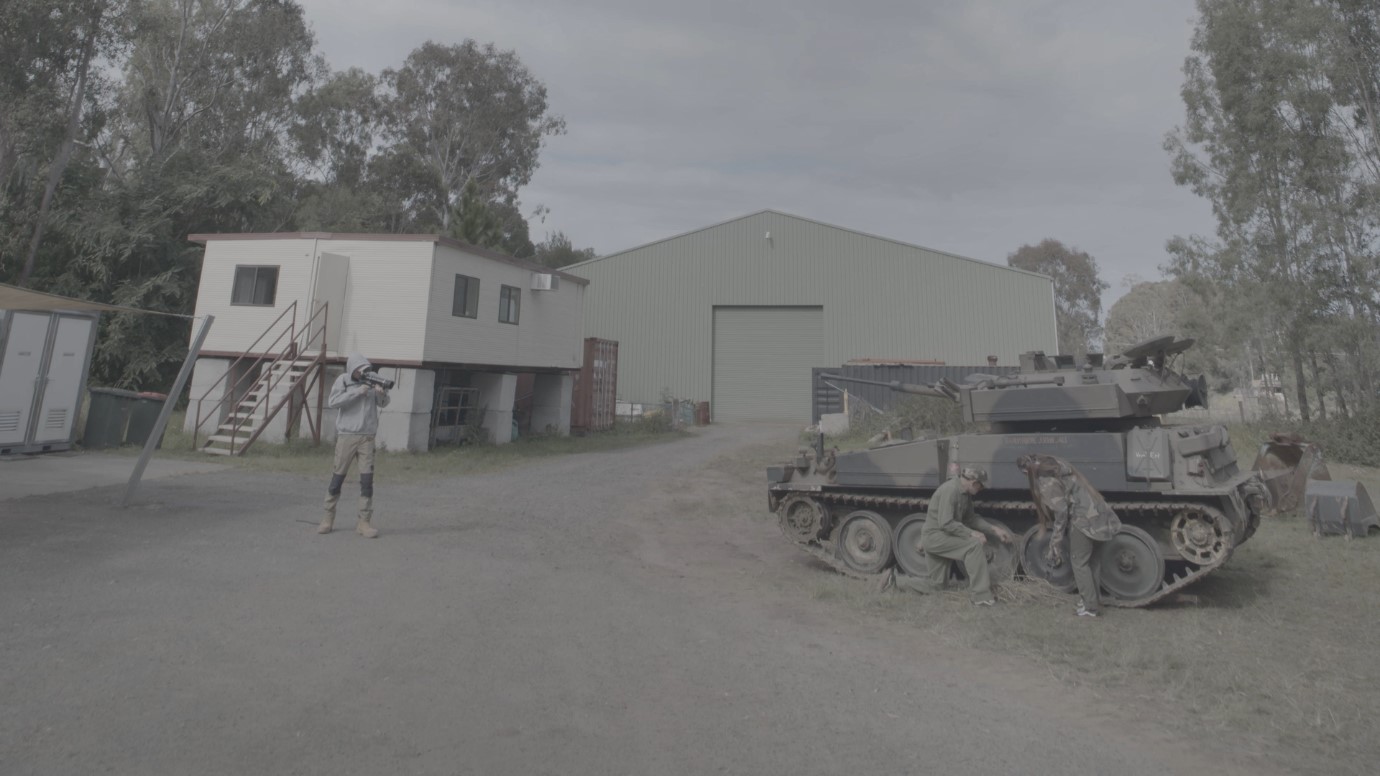
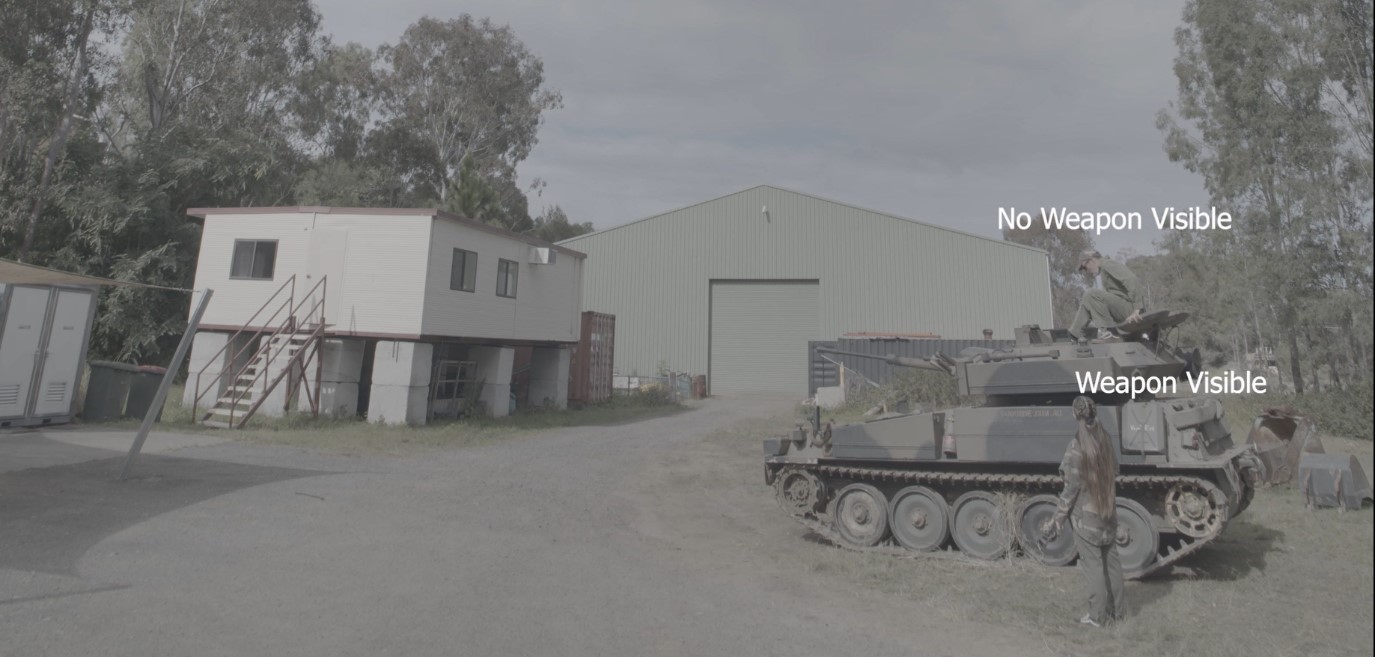
In each scenario, there was presumed to be an ethically ‘correct’ decision. For the purposes of our experiment, the ethically correct decision was always equated with the decision that IHL would require in the circumstances and that conformed to the provided rules of engagement (participants were explicitly informed of the key requirement in this regard, which was ‘positive identification for hostile intent’). In some cases, shooting was the ‘correct’ decision (e.g., the unknown person posed a genuine threat), while in others the correct decision was to refrain from shooting (i.e., there was no genuine threat). Our aim was to measure what influence, if any, the labels mimicking those generated by vision AI software such as Athena AI would have on participants’ decision-making. Would these labels increase or decrease the likelihood of the ‘correct’ decision being made, where the scenarios presented were otherwise identical and all confounding variables were controlled?
Study participants (n=81) were military cadets / trainee officers at the Australian Defence Force Academy from all services. First-year students were excluded from participating. Most students were in their third year. Most of the participants identified as male, reflecting the gender distribution of the broader cohort from which they were recruited. Almost half of the participants had completed an undergraduate University of New South Wales course in military ethics. The participants were familiar with shooting scenarios from their training and exercises. The Departments of Defence and Veterans’ Affairs Human Research Ethics Committee approved the research (# 474-22).
Each participant was shown 12 different video clips based on an orthogonal design (some clips featured labels; others did not).[22] At the start of the experiment, participants were briefed about the scenarios and their role in them:
- You are a gunner at a remote weapon system, and you are protecting dismounted personnel who are on a reconnaissance mission. Your colleagues appear on the screen near the tank in the foreground on the right.
- Your role is to provide cover fire for your colleagues. You are seated in a protected shelter 500 metres from the checkpoint. You have a camera, screen, and a remote control (mouse) with fire buttons to control the gun.
- The area of the reconnaissance mission is known to be hostile, with civilians carrying weapons. This does not identify an enemy threat force. Civilians and armed warriors from opposing forces operate in the area simultaneously.
- Your order for opening fire is a positive identification of hostile intent. The Red Card is shown during the experiment.[23]
- There are two different settings in the clips; each setting has 6 different ‘scenarios’ that are independent and (slightly) different in terms of:
- The presence/absence of AI labels (which can be correct or incorrect);
- The words in the AI labels;
- The actions and/or appearance of the other person emerging in the clips.
- Your decision in each of the 12 clips (of around 20 seconds):
- You shoot the person emerging (and the clip finishes at that point); OR
- You do not shoot the person (and the clip finishes by itself).
- After each of the 12 clips:
- Please answer two short questions presented, then
- Move to the next
Section 4: Results
In some of the scenarios, the condition of ‘positive identification for hostile intent’ was satisfied; for example, an unidentified person approaches with a rifle and takes aim at friendly forces. In other scenarios, this condition was not satisfied: an unidentified person approaches but they are holding a phone or a camera rather than a weapon. In the former set of scenarios, ‘shoot’ is classified as the correct decision (consistent with IHL and the rules of engagement), while in the latter set of scenarios, ‘no shoot’ is the correct decision (shooting would violate the rules of engagement and/or IHL).
The clips differed in a number of important respects. We varied the clarity and resolution of the video footage, the genders and ages of the role players, the attire that they wore, etc. Several of these variables had some bearing on whether the correct decision was made.
However, our results indicate that the AI-mimicking labels appearing on the screen made no statistically significant difference by themselves (see Table 1). The results in Table 1 are presented in the standard modelling format commonly used in discrete choice analyses. The values shown are parameter estimates for each of the variables, with standard errors reported in parentheses. Levels of statistical significance (i.e., p <.05, p <.01, p <.001) are indicated by asterisks. The results show a significant effect of the device carried by the emergent figure in Clip Series 1, in both the lower and higher resolution settings. The highly significant parameter of –1.72 for the variable ‘Device’ shows that switching from the rifle to the camera reduces the likelihood of a correct decision. In Clip Series 2, the device was significant in the lower resolution setting, while gender was significant in both settings. By contrast, AI labelling was not significant in any of the models. When other variables were controlled for, the presence (or lack thereof) and accuracy of labels did not affect the likelihood of a correct decision being reached by the participant.
| Variable |
Higher resolution |
Lower resolution |
|
|---|---|---|---|
| Clip Series 1 | Intercept |
0.84 |
-0.14 |
|
Device (–1: Rifle, 1: Camera) |
–1.72 |
–1.67 |
|
|
Clothing (–1: Military clothing, 1: Civilian clothing) |
–0.27* |
0.02 |
|
|
AI labelling (–1: Incorrect, 1: Correct) |
0.00 |
0.14 |
|
|
AI labelling (–1: Incorrect, 1: No label) |
0.14 |
-0.55 |
|
| R2 |
0.36 |
0.37 |
|
| Clip Series 2 | Intercept |
2.98 |
2.94 |
| Device (–1: Gun, 1: Phone) |
–0.29 |
–1.06 |
|
| Gender (–1: Female, 1: Male) |
0.55 |
0.82 |
|
|
AI labelling (–1: Incorrect, 1: Correct) |
0.44 |
–0.27 |
|
|
AI labelling (–1: Incorrect, 1: No label) |
–0.15 |
0.29 |
|
| R2 |
0.05 |
0.17 |
***, ** and * represent significance at .001, .01 and .05 levels, respectively
Section 5: Discussion and Future Directions
Our results indicate that, at least in the kinds of simplified battlefield scenarios presented to our participants, AI-generated labels intended to mitigate the ‘fog of war’ and support decision-making may not have the kinds of effects—either positive or negative—that have often been anticipated in discussions surrounding the military application of vision AI.
Contrary to both optimistic expectations and pessimistic warnings, the inclusion of these labels had no real impact on participants’ decision-making in our controlled settings. Whether participants were shown raw video footage or video enhanced with labels mimicking those that an AI system might generate (e.g., identifying individuals as armed or unarmed), their decisions on whether or not to ‘shoot’ remained largely unchanged. Across all conditions, participants appeared to rely primarily on their own direct sense perception when assessing the visual information, suggesting that the presence of AI-generated overlays had negligible influence on their ethical and tactical judgements.
Why might this be the case? One potential explanation lies in the instructions provided to participants at the start of the experiment. Participants were informed that the AI-generated labels could be inaccurate or misleading. This disclosure may have fostered a level of scepticism or distrust that led participants to discount the information contained in the labels entirely, choosing instead to rely solely on their own visual perceptions of the scenario. Since participants were led to believe that the AI assistance would not be 100 per cent reliable, it is reasonable to suppose that some of them chose to err on the side of caution and ignore the labels entirely.
However, the distrust induced by our mention of AI fallibility at the beginning of the experiment may not be the whole explanation. There may be deeper psychological or cognitive reasons for the non-effect of the AI labels.
For instance, humans often privilege direct sense perception—what they see and interpret for themselves—over mediated or second-hand information, especially in high-stakes or ethically charged situations. Familiarity bias is the tendency for people to prefer processes and tools that they know well over those that are new and foreign, even if the unfamiliar option is consciously acknowledged to be equally or more effective and accurate.[24] Thus, when a person is given information seemingly generated by a cutting-edge technology whose design and programming are opaque, that person may choose to ignore the technology and to continue relying on their own senses simply because they have relied on their senses every day throughout their lives and built up a strong, often unconscious and unexamined trust in them. This suggestion is congruent with existing literature regarding humans trusting their own judgements and having confidence in them.[25] In our experiments, it is possible that even though the participants trusted that the AI labels were probably accurate, they simply felt comparatively more comfortable relying on their own judgement when visual cues were available.
This insight has important implications for the integration of AI systems into military decision-making environments. While much has been written about the dangers of over-reliance on AI—such as blind trust in automated systems leading to potentially unethical or dangerous outcomes—our findings suggest that under-reliance on or even active disregard of AI input may also be a real and persistent phenomenon. This points to a more nuanced reality: human decision-makers may not always be as easily swayed by AI input as some proponents or critics assume.
Of course, none of this is intended to suggest that vision AI and similar technologies will never influence decisions, or that they are without value in combat or high-pressure environments. Rather, our findings challenge the assumption that such tools will always shape ethical decisions, for better or for worse. Instead, the impact of vision AI may depend heavily on context, user trust, training, and the perceived reliability of both of the technology and of the sensory environment in which decisions are being made. Future research should explore these dynamics in greater detail, particularly in more complex and stressful combat simulations where the correct ethical decision is not as obvious as it was in the scenarios that we presented.
Acknowledgements
We acknowledge that the Red Cross is a protected symbol, and a flag bearing this symbol may only be formally handed out by the ICRC. We did not have access to a formal Red Cross flag, and hence we created our own version for the sole purpose of experimentation with military AI software.
We wish to thank all ADFA personnel and trainee officers involved in this project as participants, role players and supporting personnel.
Funding
Funding for this research was granted through the Australian Army Research Scheme.
Endnotes
[1] Anna Rosalie Greipl, ‘Artificial Intelligence in Urban Warfare: Opportunities to Enhance the Protection of Civilians?’, Elgaronline 61, no. 2 (31 December 2023): 191–211, at: https://doi.org/10.4337/mllwr.2023.02.03.
[2] Filippo Santoni de Sio and Guilio Mecacci, ‘Four Responsibility Gaps with Artificial Intelligence: Why They Matter and How to Address Them’, Philosophy & Technology 34, no. 4 (2021): 1057–1084, at: https://doi.org/10.1007/s13347-021-00450-x.
[3] Shannon Vallor, ‘Moral Deskilling and Upskilling in a New Machine Age: Reflections on the Ambiguous Future of Character’, Philosophy & Technology 28 (2015): 107–124, at: https://link.springer.com/article/10.1007/s13347-014-0156-9.
[4] Dan Feldman and Nir Eisikovits, ‘AI and Phronesis’, Moral Philosophy and Politics 9, no. 2 (2022): 181–199, at: https://philpapers.org/rec/FELAAP-2.
[5] Anne Eich, Anja Klichowicz and Franziska Bocklisch, ‘How Automation Level Influences Moral Decisions of Humans Collaborating with Industrial Robots in Different Scenarios’, Frontiers in Psychology 14 (2023), at: https://www.frontiersin.org/journals/psychology/articles/10.3389/fpsyg.2023.1107306/full.
[6] David Kilcullen, ‘Future Warfare: Developing a Viable Strategy’, in Deane-Peter Baker and Mark Hilborne (eds), War 4.0: Armed Conflict in an Age of Speed, Uncertainty and Transformation (ANU Press, 2025), p. 55.
[7] Australian Army, Robotic & Autonomous Systems Strategy v2.0, 11 August 2022.
[8] James Vincent, ‘Putin Says the Nation That Leads in AI “Will Be the Ruler of the World”’, The Verge, 4 September 2017, at: https://www.theverge.com/2017/9/4/16251226/russia-ai-putin-rule-the-world.
[9] Ian Langford, ‘Accelerated Change—The Evolving Character of Society and Conflict in an Age of Speed, Uncertainty and Transformation’, in Deane-Peter Baker and Mark Hilborne (eds), War 4.0: Armed Conflict in an Age of Speed, Uncertainty and Transformation (ANU Press, 2025), p. 19.
[10] Ian J Reynolds, ‘Speed and War in US Military Thought: Mapping the Conditions for AI-Enabled Decision-Making’, Millennium: Journal of International Studies (2025), at: https://doi.org/10.1177/03058298251317205.
[11] Alex Neads, Theo Farrell and David J Galbreath, ‘Evolving Towards Military Innovation: AI and the Australian Army’, Journal of Strategic Studies 47, no. 5 (2024): 669–698, at: https://doi.org/10.1080/01402390.2023.2200588.
[12] Ian Black, ‘Dutch Troops at Srebrenica Faced “Impossible Mission”’, The Guardian, 11 April 2002, at: https://www.theguardian.com/world/2002/apr/11/warcrimes.ianblack.
[13] See Noel Sharkey, ‘Killing Made Easy: From Joysticks to Politics’, in Patrick Lin, Keith Abney and George A Bekey (eds), Robot Ethics: The Ethical and Social Implications of Robotics (MIT Press, 2012), p. 113.
[14] Imad Khan, ‘New Research Suggests Overreliance on AI Could Hinder Critical Thinking’, CNET, 12 February 2025, at: https://www.cnet.com/tech/services-and-software/new-research-suggests-overreliance-on-ai-could-hinder-critical-thinking.
[15] Kathleen L Mosier, Linda J Skitka, Mark D Burdick and Susan T Heers, ‘Automation Bias, Accountability, and Verification Behaviours’, Proceedings of the Human Factors and Ergonomics Society 40, no. 4 (1996): 204–208, at: https://journals.sagepub.com/doi/10.1177/154193129604000413.
[16] The term was introduced by psychologists Susan Fiske and Shelley Taylor in 1984 to define those who have a limited capacity to process information and who therefore take shortcuts whenever possible. Susan T Fiske and Shelley E Taylor, Social Psychology: Social Cognition (Addison-Wesley, 1984).
[17] Linda J Skitka, ‘Does Automation Bias Decision-Making?’, International Journal of Human-Computer Studies 51, no. 5 (1999): 991–1006, at: https://www.sciencedirect.com/science/article/abs/pii/S1071581999902525?via%3Dihub.
[18] Mary L Cummings, ‘Automation and Accountability in Decision Support System Interface Design’, The Journal of Technology Studies 32, no. 1 (2006): 23–31, at: https://scholar.lib.vt.edu/ejournals/JOTS/v32/v32n1/pdf/cummings.pdf.
[19] Shannon Vallor, ‘Moral Deskilling and Upskilling in a New Machine Age: Reflections on the Ambiguous Future of Character’, Philosophy & Technology 28 (2015): 107–124, at: https://link.springer.com/article/10.1007/s13347-014-0156-9.
[20] We conducted the experiments on 21 August and 18 September 2024. These were a follow-up of a pilot study conducted in 2023, which was the subject of Paper 16, presented to the October 2024 NATO Science & Technology Organization’s Research Symposium on Meaningful Human Control in Information Warfare. Christine Boshuijzen-van Burken et al., ‘Understanding Ethical Implications of AI Enabled Decision Support Systems on the Battlefield’, Research Symposium (RSY): Meaningful Human Control in Information Warfare (Amsterdam: NATO, 2025), at: https://www.sto.nato.int/document/understanding-ethical-implications-of-ai-enabled-decision-support-systems-on-the-battlefield.
[21] Athena AI, at: athenadefence.ai.
[22] Jordan J Louviere, David A Hensher and Joffre D Swait, Stated Choice Methods: Analysis and Applications (Cambridge University Press, 2000).
[23] The Red Card is a pocket-sized red card listing the baseline conditions and steps for opening fire in the Australian Army.
[24] Craig R Fox and Jonathan Levav, ‘Familiarity Bias and Belief Reversal in Relative Likelihood Judgment’, Organizational Behavior and Human Decision Processes 82, no. 2 (2000): 268–292, at: https://doi.org/10.1006/obhd.2000.2898.
[25] Patricia K Kahr, Gerrit Rooks, Chris Snijders and Martijn C Willemsen, ‘The Trust Recovery Journey. The Effect of Timing of Errors on the Willingness to Follow AI Advice’, Proceedings of the 29th International Conference on Intelligent User Interfaces (New York: Association for Computing Machinery, 2024): 609–622, at: https://doi.org/10.1145/3640543.3645167; BJ Dietvorst, JP Simmons and C Massey, ‘Algorithm Aversion: People Erroneously Avoid Algorithms After Seeing Them Err’, Journal of Experimental Psychology: General 144, no. 1 (2015): 114–126, at: https://doi.org/10.1037/xge0000033; Carey K Morewedge, ‘Preference for Human, Not Algorithm Aversion’, Trends in Cognitive Sciences 26, no. 10 (2022): 824–826, at: https://doi.org/10.1016/j.tics.2022.07.007.