
National Identity and the Will to Fight
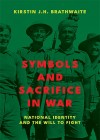
Georgetown University Press, 2025, ISBN: 9781647125783, 264pp, $44.95 USD
Author: Kirstin JH Brathwaite
Reviewed by: Andrew Frain
The relationship between national identity and combat motivation is, without question, a topic of huge importance. At the same time, there are no widely accepted authoritative accounts of that relationship; nor are there trusty playbooks for practitioners. Those charged with navigating the currents of national identity as they pertain to military effectiveness—when training and enculturating military personnel, for instance—must rely on their own intuitions or, instead, on the educated speculation of seasoned colleagues. It is in this context that we should applaud Kirstin JH Brathwaite’s attempt to bring theory and empiricism to this topic.
In Symbols and Sacrifice in War: National Identity and the Will to Fight, Associate Professor Brathwaite offers the reader a clear-cut explanation of how the strength and content of national identity relate to combat motivation, in the form of a new theory: the national identity theory of combat motivation. In this theory, high levels of willingness to fight are predicted when there is a unified national identity and when the goals of war align with the myths and symbols of that identity. The presence of either one of those, unity or alignment, will result in minimally adequate willingness to fight.
The striking simplicity of the theory is likely to win over some readers. Other readers, however, will worry whether a theory so clear cut will inevitably be an overreach. Is too much overlooked in the accompanying analysis of combat motivation? It is a brief treatise, after all, with six chapters across approximately 200 pages. The book begins with a theory and methods chapter, followed by one chapter analysing national identity and other structural elements across Second World War British imperial forces, then a chapter for each of the Malayan, North African and European operational theatres. Unfortunately, yes, by the concluding chapter, the reader is never within reach of meaningful support for tenets of national identity theory. Such is the gulf between evidence and conclusion that it is worth reverse-engineering the book’s core argument so as to understand how that gulf arose.
National identity theory appears to have been tilted off course by the choice to develop the theory as an antidote to small-unit cohesion analyses of combat motivation. As the author tells it, small-unit cohesion is, by and large, the dominant explanation for combat motivation, such that any other contributing factors are diminished or outright disregarded. That characterisation of the relevant literature is a distortion. Small-unit cohesion perspectives largely arose to refute the widespread presumption that larger-scale sociological structures, such as religions or nationalities, will be the most potent source of commitment to a military cause.[1] The small-unit cohesion message is simply that it is common for soldiers to be highly motivated to protect the dignity and safety of those who share the same lived experience as them (i.e., those within the ‘band of brothers’[2]).
It is the act of stripping small-unit cohesion analyses of that analytical context,[3] and caricaturing them into a standalone and complete theory of combat motivation, that allows national identity theory to be pitched as a crucial missing piece of the puzzle. And that might have been fine—unnecessarily adversarial to the extant literature, yes, but not fatal for the argument. The irrevocable damage occurred when the author went on to adopt a bold and implicitly quantitative position: in general, national identity will trump small-unit cohesion as a driver of combat motivation. Such a quantitative position requires, of course, quantitative substantiation—substantiation that cannot be achieved with the limited qualitative data presented across chapters.
The data in question, as selected by the author, is combat performance across British, Indian and Australian forces. And while the operational and tactical accounts are compelling, they are a narrow selection. The author suggests that limiting data collection to those forces and theatres allows us to maximise comparability on key dimensions by controlling for other factors (e.g., the adversary, material circumstances, doctrine), just as one would in a quasi-experiment. To be sure, such an approach would be excellent for demonstrating that national identity has the potential to impact combat motivation. It is not, however, a suitable way of determining (a) when it will, and (b) to what extent. For one thing, in quantitative research, control comes at the expense of generalisability; each factor held constant raises a question about ecological validity.
More concerning still, and by the author’s own admission, across the militaries and theatres placed under the microscope, very limited data was available on truly small-unit cohesion (e.g., platoon or company). Instead, the book’s analysis targeted battalion and brigade-level indicators (e.g., the UK regimental system, the brevity of pre-deployment training for Australian forces). These are a poor proxy for the often highly localised and organic bonding that the small-unit cohesion analysis attempted to bring to light.[4] It should be obvious that without sufficient data or source material on small-unit cohesion, one cannot reasonably make claims about the importance of national identity for combat motivation and effectiveness. Certainly one should not make the concluding claim, as the author does, that those seeking to foster combat effectiveness need not pay much mind to small-unit cohesion and should instead focus on leveraging national-level phenomena: ‘there is no need to worry about social cohesion within small units as it is neither necessary nor sufficient for creating will to fight’.[5] At bare minimum, such an assertion should be tentative and be balanced with an acknowledgement of empirical findings that suggest the opposite. For instance, an Israeli Army study found that focusing on national identity was associated with lower company potency.[6]
It is worth repeating that the book’s topic of study, national identity as it impacts combat motivation, deserves the attention it has received in this book, and more. It is appallingly understudied. Indeed, readers might consider the path not travelled. In another version of this book, or perhaps in a future edition, one could begin with the uncontroversial position that national identity is almost certainly one of a number of factors that can impact combat motivation and operational effectiveness. The manner in which national identity has that impact could then be investigated through the lens of established models of persuasion and organisational commitment.[7] Upon that foundation, we could be treated to a rich exploration of the many ways that national identity and mythology are expressed and sustained by symbolism (e.g., images, stories, rituals), as well as the manner in which national identity may be aligned or misaligned with the attitudes, experiences and motivations of military members in the preparation for, and during, conflict.[8]
Symbols and Sacrifice in War does offer readers the occasional rich treatment and novel insight that this topic deserves. Unfortunately, by heedlessly seeking to establish national identity theory as the foremost consideration for combat motivation, much opportunity is missed. Despite this, for academics interested in the psychology and sociology of morale and combat effectiveness in contemporary Western militaries, this text is thought-provoking and worth one’s time. For military practitioners in search of solid analytical footing on which to base their actions and advice, I would instead recommend Anthony King’s The Combat Soldier: Infantry Tactics and Cohesion in the Twentieth and Twenty-First Centuries (2013).
Endnotes
[1] In the words of one First World War general, ‘I came out of the war with the definite impression that [comradeship] was perhaps the strongest constructive moral factor, stronger than patriotism, and in many cases stronger than religion’—Chester I Barnard, The Functions of the Executive (Harvard University Press, 1938), p. 148.
[2] William Shakespeare, Henry V (n.d.).
[3] One should always remember that ‘no intellectual theory can be properly understood merely in terms of what the theorist is proposing, but it also needs to be seen in terms of rival ideas which the theorist is opposing’—Michael Billig, ‘Remembering the Particular Background of Social Identity Theory’, in WP Robinson (ed), Social Groups and Identities: Developing the Legacy of Henri Tajfel (Butterworth-Heinemann, 1996), p. 341.
[4] Early examples are Leornard Berkowitz, ‘Group Norms Among Bomber Crews: Patterns of Perceived Crew Attitudes, “Actual” Crew Attitudes, and Crew Liking Related to Aircrew Effectiveness in Far Eastern Combat’, Sociometry 19, no. 3 (1956): 141–153; Daniel M Goodacre, ‘Group Characteristics of Good and Poor Performing Combat Units’, Sociometry 16, no. 2 (1953): 168–179; Edward A Shils and Morris Janowitz, ‘Cohesion and Disintegration in the Wehrmacht in World War II’, The Public Opinion Quarterly 12, no. 2 (1948): 280–315.
[5] Kirstin JH Brathwaite, Symbols and Sacrifice in War: National Identity and the Will to Fight
(Georgetown University Press, 2025), p. 199.
[6] Boas Shamir, Eliav Zakay, Esther Brainin and Micha Popper, ‘Leadership and Social Identification in Military Units: Direct and Indirect Relationships’, Journal of Applied Social Psychology 30, no. 3 (2000): 612–140.
[7] John C Turner, ‘Explaining the Nature of Power: A Three-Process Theory’, European Journal of Social Psychology 35, no. 1 (2005): 1–22; John P Meyer, David J Stanley, Lynne Herscovitch and Laryssa Topolnytsky, ‘Affective, Continuance, and Normative Commitment to the Organization: A Meta-Analysis of Antecedents, Correlates, and Consequences’, Journal of Vocational Behaviour 61, no. 1 (2002): 20–52.
[8] The qualitative analysis would ideally be coupled with two further elements: a) quantitative observations, such as enlistment rates and measures of national identification, and b) theorising on the fingerprint that national identity, or similar social identities, will have in the asymmetrical and technologically enabled conflicts of the 21st century, often involving ideologically driven non-state actors.