
General Douglas MacArthur as a Wartime Commander
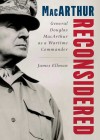
Stackpole Books, 2023 288 pp
ISBN: 9780811771580
Author: James Ellman
Reviewed By: Dayton McCarthy
It is said that Napoleon Bonaparte once quipped that he would ‘rather have lucky generals than good ones’. Certainly luck—or the fortune of circumstances—has played its part in any military defeat or success. Therefore, we might correctly assume that lucky generals are probably therefore successful ones. After reading James Ellman’s short and punchy book on General Douglas MacArthur, the reader will certainly conclude that this ‘American Caesar’ enjoyed inordinate amounts of good fortune repeatedly during his long career.[1] What is more, MacArthur’s luck was rarely that of a risky battlefield gambit—the Inchon landing an exception—coming up trumps. Instead, his luck was something different. Due to contemporaneous political or military circumstances, he avoided sacking or even censure on multiple occasions. This, coupled with his penchant for self-aggrandisement through spin-doctoring his actions, meant that MacArthur was not only able to survive his numerous mistakes but also to burnish his reputation further.
Australian Army Journal readers are probably aware of MacArthur’s actions in the South West Pacific Area (SWPA). This includes the machinations to sideline General Sir Thomas Blamey as the notional commander of the Allied land forces, the manipulation of Prime Minister John Curtin and the willingness to use Australian troops early on but then excluding them once he had sufficient American troops in theatre. They are less likely to know the multiple egregious overreaches MacArthur demonstrated in Korea. In MacArthur Reconsidered’s later chapters, Ellman illustrates that the denouement to MacArthur’s military career was one of insubordination towards higher political and military strategic leaders and fantastical post factum justifications for poor decision-making. Ellman pithily asks those who would still revere MacArthur: if a pattern of insubordination by a senior military leader of the Unites States is acceptable behaviour, what exactly would they consider to be unacceptable conduct?[2]
Ellman demonstrates that features of MacArthur’s later actions and behaviours were identifiable early in his career. After service in the First World War, MacArthur enjoyed a meteoric rise up the ranks and was chief of staff of the army in 1930. He also began a long association with the Republican Party. In 1932 he courted controversy when he disobeyed President Hoover’s explicit orders to not enter a camp of destitute veterans who had encamped in Washington, demanding that their retirement bonuses be paid out immediately. Instead, MacArthur entered these camps with infantry, cavalry and tanks. A riot ensued and a public relations disaster was caused. Nonetheless Hoover chose not to discipline MacArthur. Ellman writes that:
if MacArthur learned a lesson from his actions, it was that he could safely disobey or ignore orders from superiors as long as he could produce a ‘victory’ and retain a large portion of [the Republican Party]. It was a path he would turn to repeatedly over his career.[3]
The next major failure covered by Ellman was MacArthur’s defence of the Philippines during the Japanese invasion in December 1941. In essence, MacArthur disregarded decades of war planning—which included the caching of all important stores—and in doing so unhinged the military defence so that it was continually wrong-footed by a smaller Japanese force. This resulted in the retreat to the island fortress of Corregidor, which was slowly reduced by the encircling Japanese forces over several months. As we know, MacArthur was ordered to Australia with his headquarters staff (with MacArthur also taking his wife and child). The garrison fell and its defenders went into years of Japanese captivity. Ellman makes a point of comparing the fates of the US leaders caught by surprise at Pearl Harbor, who were summarily dismissed, with that of MacArthur, who not only lived to fight another day but was able to reinvent himself in Australia.
In retelling MacArthur’s time in the SWPA, Ellman covers some well-trodden ground. This includes the dysfunctional nature of his staff, most notably his grossly incompetent intelligence chief, Charles Willoughby. We are regaled with many instances of his self-serving communiqués and his bad habit of pre-emptively declaring an operation completed (perhaps with some perfunctory ‘mopping up’) when it was still in its bloody throes. At the operational-strategic level, Ellman deals satisfactorily with the tension between MacArthur’s preferred land-centric course of action of attacking Japan via New Guinea and the Philippines versus Admiral Chester Nimitz’s and Admiral Ernest King’s air- and maritime-centric advance through the central Pacific. Here we see MacArthur argue with the Joint Chiefs of Staff; again, MacArthur suffered no consequences.
Despite his age, MacArthur would initially lead the fight in the Korean War. In part, this was because President Truman, a Democrat, wanted MacArthur, who had expressed interest in being the Republican presidential nominee, as far away from the domestic political scene as possible. Ellman recounts the ebbs and flows of that war with all of MacArthur’s missteps as well as his crowning glory with the Inchon landings. Ellman considers that the missteps overshadow this one success. The Korean War seemingly exacerbated all of MacArthur’s extant flaws: his communiqués became increasingly riddled with falsehoods or delusional assessments; he shifted blame for his failures elsewhere and quarrelled with the Joint Chiefs of Staff often. Most notably MacArthur became more emboldened and careless in challenging the authority of the President. However, matters came to head. Truman, who had considered sacking MacArthur earlier, was left with no choice after MacArthur tried to unilaterally scuttle ceasefire talks with China. After his removal from command, his successor, General Matthew Ridgway, described MacArthur thus:
I came to understand some traits of his complex character not generally recognised: the hunger for praise that led him on some occasions to claim or accept credit for deeds he had not performed, or to disclaim responsibility for mistakes that were clearly his own; the love of the limelight that continuously prompted him to pose before the public as the actual commander on the spot.[4]
Therefore, it comes as no surprise that Ellman’s assessment of MacArthur as a wartime commander is not complimentary. In this regard, Ellman’s book joins a growing body of histories that reassess MacArthur’s actual battlefield performance against the accepted historical narrative—a narrative that MacArthur, through his post-action reports and communiqués, assiduously created himself. The question then is whether MacArthur Reconsidered, which covers his commands in the Second World War and the Korean War, adds much new to this revisionist school of military history.
There is a lot to commend in Ellman’s book. It is readable and generally does a good job of condensing strategic and operational contexts to frame the correctness or otherwise of MacArthur’s wartime performance. At times, this can come across as an oversimplification of events. This reviewer also felt that Ellman’s lack of a military background was evident in some assessments of MacArthur. Likewise, in his desire to illustrate MacArthur’s well-documented duplicity and self-promotion, Ellman sometimes goes too far in his condemnation of his subject. For example, he places almost the entirety of the blame for the US military’s initial poor performance in Korea to MacArthur’s failure to train the occupation troops in Japan. In doing so, he ignores the poor state of the forces caught in the usual postwar malaise.[5] This does not make the book wrong but it highlights that, in effect, MacArthur Reconsidered is a precis. Ellman does a good job in covering the key failures (and some notable successes) that characterised MacArthur’s career, by referencing selected revisionist works. However, Ellman has not used primary or archival resources, so the book offers the reader no new analysis of or perspectives on MacArthur.
If Australian Army Journal readers are coming to MacArthur ‘cold’, then Ellman’s MacArthur Reconsidered is a good start. For those that already have a working knowledge of this fabled but flawed general, this reviewer would recommend three other books instead. The first is Peter J Dean’s MacArthur’s Coalition: US and Australian Military Operations in the Southwest Pacific Area, 1942–1945.[6] The second gives a view of MacArthur from the perspective of one of his no-nonsense subordinates: Kevin C Holzimmer’s General Walter Krueger: Unsung Hero of the Pacific War.[7] For this reviewer, the best option would be John C McManus’s excellent three-volume series on the US Army in the Pacific in the Second World War.[8] Readers will find Dean’s, Holzimmer’s and McManus’s portrayals of MacArthur far more nuanced (and contextualised) than that contained within MacArthur Reconsidered, and of more use in developing a balanced assessment of him as a military commander.
Endnotes
[1] William Manchester, American Caesar (New York: Dell Books, 1981).
[2] James Ellman, MacArthur Reconsidered: General Douglas MacArthur as a Wartime Commander (Lanham MD: Stackpole Books, 2023), p. 236.
[3] Ibid., p. 14.
[4] Ibid., p. 223.
[5] Ibid., pp. 156–157. For further exploration, see Brian McAllister Linn, Real Soldiering: The US Army in the Aftermath of War, 1815–1980 (Lawrence KS: University Press of Kansas, 2023).
[6] Peter J Dean, Macarthur’s Coalition: US and Australian Military Operations in the Southwest Pacific Area, 1942–1945 (Lawrence KS: University Press of Kansas, 2018).
[7] Kevin C Holzimmer, General Walter Krueger: Unsung Hero of the Pacific War (Lawrence KS: University Press of Kansas, 2007).
[8] John C McManus, Fire and Fortitude: The US Army in the Pacific War, 1941–1943 (New York: Dutton Caliber Press, 2019); John C McManus, Island Infernos: The US Army’s Pacific War Odyssey, 1944 (New York: Dutton Caliber Press, 2021); John C McManus, To the End of the Earth: The US Army and the Downfall of Japan, 1945 (New York: Dutton Caliber Press, 2023).