
General Douglas MacArthur as a Wartime Commander
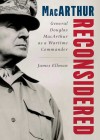
Stackpole Books, 2023, 277 pp
ISBN: 9780811771580
Author: James Ellman
Reviewed by: Liam Kane
Of the British and US generals who led armies and army groups in the campaigns in western Europe in 1944 and 1945, the soldier and historian Reginald Thompson wrote, ‘Some of them seem to cast gigantic shadows, and the shadows were mistaken for the men’.[1] MacArthur too cast a big shadow—such were his temperament, fortune, privileges, responsibilities and reputation. While it is probably impossible to separate this man from his shadow, many have tried, and thanks to their efforts we have a kaleidoscopic portrait of the man that changes depending on the biographers’ interests and feelings about him. James Ellman’s MacArthur Reconsidered adds relatively little to scholarship on MacArthur but it nonetheless raises points about his military career and the nature of military biography that are worthy of consideration.
Readers are not deprived of books about MacArthur. Even if histories of the Second World War and the Korean War in which MacArthur figures prominently are excluded, a substantial reading list remains. His memoir, Reminiscences, was published in 1964 (the year of his death).[2] Three years later, the Department of the Army published the administrative history of General Headquarters, South West Pacific Area (GHQ) as Reports of General MacArthur.[3] Of the traditional life and times style biographies of MacArthur, the best-known works are D Clayton James’s The Years of MacArthur (its three volumes were published between 1970 and 1985) and William Manchester’s popular American Caeser (published in 1978).[4] There are also narrower accounts of MacArthur as a commander such as Gavin Long’s MacArthur as Military Commander and Richard Frank’s MacArthur, published in 1969 and 2007 respectively.[5] Ellman’s MacArthur Reconsidered falls into this last category, being a brief narrative account of MacArthur’s life focusing on his higher command experiences in the Second World War and the Korean War.
Ellman describes MacArthur Reconsidered as a corrective to the existent ‘literature on MacArthur’, which in his view consists of biographies ranging from ‘complementary to idolatrous’ and ‘a few volumes that conclude that he [MacArthur] was a brilliant but flawed leader’. Ellman emphatically argues that MacArthur was a flawed, poor commander.[6] While Ellman thus sets himself against his predecessors, he nonetheless relies heavily on their works because he appears to have done no substantial archival research of his own. The emphasis that Ellman places on his use of ‘letters, transcriptions of radio messages, diary entries, and memoirs’ is thus misleading.[7] It is entirely possible for fresh archival research to shed new light on MacArthur’s performance as a commander, even if revelations equalling the insights provided by material concerning Japanese radio communications intercepted and exploited by GHQ—declassified in the 1970s and 1980s—are probably not on the horizon.[8]
Ellman surveys the most contentious issues in MacArthur’s career, but his judgements are mostly unconvincing. He is not necessarily wrong. This reviewer strongly agrees with some of his points. For example, Ellman rightly faults MacArthur for pushing too hard to drive the Japanese entirely out of the Philippines in 1945. This approach was unwarranted and resulted in unnecessary destruction.[9] Ellman’s problems are a tendency to overstate his arguments, and lack of attention to detail and context.
Take an example from the war in the Pacific. Here the Joint Chiefs of Staff maintained two area commands: the Pacific Ocean Area under Admiral Chester Nimitz and the South West Pacific Area under MacArthur. This command arrangement and the reluctance of the Joint Chiefs of Staff to clearly prioritise one theatre over the other remain controversial. Weighing in on this debate, Ellman claims that resources spent taking Dutch New Guinea in 1944 in MacArthur’s theatre would have been more wisely used in Nimitz’s theatre to take the Mariana Islands earlier to commence strategic bombing of Japan sooner.[10] Ellman echoes the Chief of Naval Operations and member of the Joint Chiefs of Staff Admiral Ernest King, who regarded the Marianas as a key objective for the Allies. King’s agenda competed with MacArthur’s agenda to get to the Philippines via Dutch New Guinea and the Bismarck Islands. In March 1944, the Joint Chiefs of Staff instructed the theatre commanders to advance both to the Marianas and into Dutch New Guinea. Ellman attributes this compromise to the success that MacArthur apparently achieved in improperly imposing his ‘will’ on the chiefs to shape strategy.[11] This misrepresents a complicated decision-making process in which the Joint Chiefs of Staff and their advisers considered many factors, of which MacArthur’s pressure was only one consideration—albeit an important one. They opted to advance along two axes because these courses of action were not mutually exclusive. In fact, they supported one another to some extent.[12]
Most of Ellman’s other points—summarised in dot-point form in the book’s conclusion—feature similar carelessness.[13] Take another example: the charge that MacArthur’s supposed lack of interest in training significantly contributed to the ill-preparedness of the US Eighth Army for war on the Korean Peninsula.[14] The problems in the Eighth Army were at least as much the result of institutional problems in the US Army as they were of MacArthur’s leadership. Further, MacArthur, in fact, took some interest in training. An amphibious training program in Far East Command that he initiated was interrupted by the outbreak of the war.[15]
Ellman is at his most rigorous when identifying distortions of the truth in MacArthur’s memoir and GHQ’s infamous communiqués during the Second World War. His commentary on the Papuan campaign in 1942 and 1943 reminds readers how carefully GHQ managed the public narrative of the war in the theatre.[16] Yet MacArthur’s penchant for self-aggrandisement and dishonesty is well known. Catching him or one of his staff officers in lies or half-truths does not tell us anything about him that was not already known.
Future scholars of MacArthur may wish to come to their subject with a clear sense of military command as a social phenomenon. Ellman provides a sort of ‘good commander checklist’, including duties pertaining to preparation of forces, management of subordinates, civil–military relations and personal integrity.[17] Such lists are useful as far as they go, but others may wish to conceptually extend themselves. Carol Petillo’s psychoanalysis-informed account of MacArthur’s life in the Philippines remains the most forthright attempt to theorise in a biographical treatment of MacArthur.[18] While Freud may again be put to work on MacArthur, studies of military command are perhaps the more obvious place for a future writer to look for conceptual resources. The most useful study in this regard is Anthony King’s study of divisional command in the 20th and 21st centuries, Command. This book is not without its problems (King’s history is a bit patchy) and does not pertain to MacArthur’s level of command in the Second World War and the Korean War. Yet King’s conceptualisation of command would nonetheless provide a useful starting point.[19]
MacArthur Reconsidered would be of some interest those interested in MacArthur and his wars, and higher command in general. Seasoned readers will not find anything new here but they may find Ellman’s criticisms thought-provoking. Newcomers are better off starting with Frank’s MacArthur. The appropriate point to end this review on is not which biography of MacArthur to read but on a question: why study the man at all? The temptation to derive clean positive or negative lessons about command from MacArthur’s career should be resisted because they are not there. What we see in him as a commander are flashes of different facets of high command in the 20th and 21st centuries—such as the porous boundary between political and military expertise in war and the fine line between the healthy contesting of ideas and internecine rivalries in bureaucratic decision-making. These topics are best understood with the relevant context and particulars in mind.
Endnotes
[1] Reginald Thompson, The Battle for the Rhineland (Yardley PA: Westholme Publishing, 2012 [1958]), p. xi.
[2] Douglas MacArthur, Reminiscences (London: William Heinemann Ltd, 1964).
[3] Reports of General MacArthur: The Campaigns in the Pacific (Washington DC: Center for Military History, 1966/1994).
[4] D Clayton James, The Years of MacArthur: Volume I: 1880–1941 (Boston MA: Houghton Mifflin Company, 1970); D Clayton James, The Years of MacArthur: Volume II: 1941–1945 (Boston MA: Houghton Mifflin Company, 1975); D Clayton James, The Years of MacArthur: Volume III: Triumph and Disaster, 1945–1964 (Boston MA: Houghton Mifflin Company, 1985); William Manchester, American Caesar: Douglas MacArthur, 1880–1964 (Boston MA: Little, Brown Company, 1978).
[5] Gavin Long, MacArthur as Military Commander (Sydney: Angus and Robinson, 1969); Richard Frank, MacArthur (New York: Palgrave MacMillan, 2007).
[6] James Ellman, MacArthur Reconsidered: General Douglas MacArthur as a Wartime Commander (Lanham MD: Stackpole Books, 2023), pp. 2–3.
[7] Ibid., p. 5.
[8] Ed Drea, MacArthur’s Ultra: Codebreaking and the War Against Japan, 1942–1945 (Lawrence KS: University Press of Kansas, 1992).
[9] Ellman, MacArthur Reconsidered, p. 234.
[10] Ibid., pp. 107–108, 234.
[11] Ibid., p. 107.
[12] Forrest Pogue, George C. Marshall: Organiser of Victory (New York: Viking Press, 1973), pp. 438–447; Grace Person Hayes, The History of the Joint Chiefs of Staff in World War II: The War Against Japan (Annapolis MD: United States Naval Institute Press, 1982), pp. 543–568.
[13] Ellman, MacArthur Reconsidered, pp. 232–236.
[14] Ibid., pp. 155–157.
[15] For the Eighth Army see Thomas Hanson, Combat Ready? The Eighth U.S. Army on the Eve of the Korean War (College Station TX: Texas A&M University Press, 2010), pp. 13–44; For amphibious training see Donald Boose, Over the Beach: US Army Amphibious Operations in the Korean War (Fort Leavenworth KS: Combat Studies Institute Press, 2008), pp. 81–83.
[16] Ellman, MacArthur Reconsidered, pp. 91–95.
[17] Ibid., p. 3.
[18] Carol Petillo, Douglas MacArthur: The Philippines Years (Bloomington IN: Indiana University Press, 1981).
[19] Anthony King, Command: The Twenty-First Century General (Cambridge: Cambridge University Press, 2019). For criticisms of Command see Tim Bean, Edward Flint, James Kitchen and Paul Latawski, Orchestrating Warfighting: A History of the British Army’s Corps and Divisions at War Since 1914 (New York: Routledge, 2025), p. 77.