
Australians and the War in Burma 1942–1945
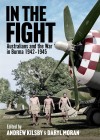
Big Sky Publishing, 2024 412 pp, ISBN 9781923144552
Editors: Andrew Kilsby and Daryl Moran
Reviewed by: Jean Bou
Two Victorian historians, Andrew Kilsby and Daryl Moran, have put together an edited book examining the role of Australians in the Burma Campaign of 1942–1945. By their telling, the book stemmed from researching and writing a history of the involvement of Australians in that campaign’s air war. In doing so they kept stumbling across other Australians that the war had brought to India and Burma. So plentiful were these examples that Kilsby and Moran decided the subject deserved a book in its own right, and this is the result.
The collection includes a dozen chapters by a dozen authors, each on a different topic, that trace out some aspect of Australian involvement. Because there was no specific Australian military contribution to the Burma Campaign, the chapters are largely what might be described as ‘incidents of the war’. That is, the ebb and flow of the war, imperial connections and a common foe led to Australians being there, either as individuals or as part of some group. So in this vein, for example, Karl James has written about special operations, Meghan Adams about women Red Cross volunteers in Ceylon, and Kama MacLean about Richard (RG) Casey’s time as Governor of West Bengal as it was afflicted by famine.
In doing so, the authors have cast light into niches of what is already a niche part of Australia’s war history. It is a trite habit of publishers to claim that a history book examines something ‘forgotten’ (all history is more or less forgotten), but in this case the claim is accurate enough. The book’s main value lies in featuring these relatively obscure experiences. In this way, it gives the individuals and groups a historical legacy while also offering a valuable insight into, and reminder of, how everyone’s war was different. We tend to think of wars as collective experiences, and they are that. More broadly, however, the currents of the war meant that individuals were taken to unexpected places to do unexpected things, and the kaleidoscopic range of stories in this book testifies to that variety. In doing so it also underlines how the ties of empire meant that certain Australians were drawn into a theatre of war that was of lesser importance to the rest of their compatriots.
The editors have seemingly decided to emphasise these individual stories. Their own chapter about the air war, for example, provides enough about this aspect of the campaign to give some structure but focuses mostly on the experiences of Australian individuals in it. The result is a collection of personal vignettes but little historical analysis of the institutional, military and political currents or issues. If you are wondering about the conduct of the campaign, an examination of the institutions, the links of empire or policy debates, even as they pertained to Australia and the people it provided, you will have to look elsewhere.
Moreover, the attention to personal stories gives many of the chapters a ‘bitsy’ feel. Few individuals were directly involved in the war, let alone this theatre, from beginning to end. The war drew people in, and circumstances usually took them out again at some point, be it from illness, wounding, capture or death, or the banalities of belong posted somewhere else, or their specific utility coming to an end. The result is a collection of brief mentions of individuals as they have their moment in this book’s sun. Some of them were undoubtedly noteworthy in their own way. That the famous ‘hump’ air route over the Himalayas was pioneered by an Australian, Sydney de Kantzow, flying for a Chinese airline is a small historical gem, for example. In other cases, however, the material is less rewarding. Karl James has laboured mightily to eke out a chapter about Australian special operations personnel in the theatre, but it is apparent that he had a patchy historical record to draw on.
For these reasons it is perhaps not surprising that the chapters that tend to work best are those that have a stronger collective or institutional element to them. Tom Lewis’s chapter on the Royal Australian Navy in the Indian Ocean, for example, includes personal aspects while remaining well anchored by the progress of ships and episodes of the war at sea. Meghan Adams on the women of the Australian Red Cross, and Jaqueline Dinan on the Women’s Auxiliary Service are similarly aided by having an organisation to hang the subject’s experiences from. The same can be said of David Mitchelhill-Green’s arresting chapter on pioneering and maintaining Qantas’s remarkable wartime Indian Ocean route.
The book’s emphasis on personal vignettes should not dissuade you if you have a particular interest in the Burma Campaign or in pushing your knowledge into rarely explored aspects of Australia’s war history. In the Fight is a collection of well researched and written chapters. It is, to this point, probably the only place where you will find a concise treatment of Australians in the campaign—something that is unlikely to change in the foreseeable future.